The corral has been quieter than ever before over the last three days. From over one hundred and seventy runners, just two remain. Seventy-two laps are behind them. They had both finished the last lap almost side by side, with seconds to spare. The bell sounds a seventy-third time and they both step forward.
There is no surge of speed. Just rhythm, fragile and hard-earned. The course, worn down by hundreds of runners, feels different now. The rain has played its part. It is softer in places and harder elsewhere. The runners settle into the loop.
After a while, the first runner appears on the final approach. There is no celebration, no exuberance. Just a runner focused on finishing what he started. He crosses the line, still within the hour. Minutes pass. The second runner does not appear. It is over. The bell does not need to ring again.
After more than three days and over three hundred miles, only one runner remains. He had stood at that same spot seventy-two times before. The difference this time is that he is alone. He is the last man standing.
That was how the ‘Last Man Standing’ ultra marathon race ended at Bare Ranch in Liberty Hill, just outside Austin, TX.
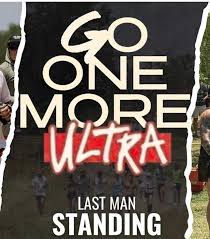
Nick Bare, founder of Bare Performance Nutrition, started hosting this race, known as ‘Go One More Ultra,’ after becoming interested in the backyard ultra marathon format. Though still relatively young, the race already attracts elite ultrarunners and a global audience that follows it through livestreams.
Backyard ultra marathons are simple in concept. The course is a 4.167-mile loop. A new lap begins every hour, on the hour. If you fail to start, you are eliminated. The race continues until only one runner remains. Unlike traditional marathons or ultramarathons, there is no fixed finish line and no predetermined distance. The race could last a day, two days, or, as seen this year, stretch into a fourth. It is not just a test of endurance, but also a psychological battle and a challenge of sleep deprivation.

Why that specific distance? Running 4.167 miles every hour adds up to one hundred miles in 24 hours. Most participants complete each loop in 45 to 50 minutes, leaving them with roughly ten minutes between laps. In that short window, they rest, hydrate, eat, tend to blisters, change gear, and sometimes grab a brief nap.
At the next hour, they must be back in the starting corral. Miss the start, and they are marked DNF (Did Not Finish). Fail to complete the loop within the hour, and they are out. This cycle repeats until only one runner is left, however long it takes.

In 2025, the final two were Kendall Picado Fallas of Costa Rica and Germany’s Kim Gottwald, who had each completed 56 laps. However, during their 57th lap, a severe thunderstorm with lightning forced organizers to stop the race, and both were declared joint winners. Naturally, there were high expectations that they would face off again this year.
Instead, it was Mark Dowdle from the United States who stood out, completing a staggering 73 laps, covering over 300 miles. Kendall finished with 72 laps, while Kim completed 58. In this format, it is worth noting that everyone except the winner is recorded as DNF, regardless of how far they go. The current world record in the backyard ultra format is held by Australian Phil Gore at 119 hours, over 495 miles, achieved at Dead Cow Gully, Australia in June 2025.
An important part of this setup is the support crew. The size of the crew varies by race, and here a maximum of three members was allowed. In many ways, they function like a pit crew in an F1 race. They take over the moment the runner finishes a lap, handling food and fluids, managing gear, treating blisters, monitoring hydration, waking the runner from short naps, and offering emotional support. Their role is critical in helping the runner go back out each hour. However, all assistance is limited to the time between laps. Once a lap begins, no external aid is allowed. Runners may carry water, hydration gels, or small snacks, but unlike a marathon, there are no aid stations on the course.

In keeping with the spirit of the format, there is no prize money attached to the race. Runners compete for recognition and reputation rather than financial reward. For elite athletes, a strong performance can open doors to sponsorships, but that is secondary. At its core, the motivation is simple and deeply personal. The winner is not chasing a payout, but the knowledge that he was able to go one more lap than everyone else.
Elite athletes are invited by the organizers, while others register and are typically selected through a lottery. This year, there were close to one hundred and seventy runners on the roster. One such first-time participant was Nakul Rao, who completed an impressive nineteen hours, covering nearly eighty miles. While new to the backyard ultra format, Rao is no stranger to endurance events, having taken part in multiple marathons and Ironman races.

Rao offered an insider’s perspective. The question he is asked most often is why. His answer is simple: why not? He believes that pushing his body to its limits makes him stronger, not just physically but as a person. It prepares him to step up when needed in everyday life and helps him stay calm under pressure. For him, life is a collection of stories, and not all of them have to come from races like this. They could occur during training or during a casual lap. These are stories he loves to share.
He entered the race with two goals: to complete one hundred miles and to see how far he could push himself. He came close to the first and was proud of how far he went on the second. When asked how he felt at the start versus the end, he described the beginning as a mix of emotions. There was excitement, stress, uncertainty, fear, and calm, all at once. By the end, however, his mind was completely blank. He had given everything in the final lap, and there was nothing left to process. Later, after IV fluids and some recovery, he felt a deep sense of pride in not giving up.
One striking aspect of the race, he said, was the lack of hostility among competitors. Every runner wanted the others to go one more lap. They leaned on each other for motivation. Sometimes it was a word of encouragement, sometimes a shared laugh, and sometimes just the steady rhythm of footsteps around them. Friendships were formed over those long hours, and he looks forward to carrying them forward.

Rao also spoke about the lessons he learned. With only an 8 to 10 week training block, he focused on building endurance and simulating race conditions, including running repeated loops and learning how to conserve energy. He has already lined up several races for later this year. The next major one he is excited about is the iconic Georgia Death Race, an approximately 74-mile trail race with over 16,000 feet of elevation gain.
His advice is straightforward. Do not get discouraged by what others say. Start somewhere. The effects of compounding apply not just to finances, but also to habits. Not everyone needs to run ultramarathons, but there is value in pushing yourself in whatever you choose to do.

Or, as an ethos of the Last Man Standing Ultramarathon format says, “Die on the course, not in the chair”!



1 comments:
This was inspiring - https://www.facebook.com/share/v/18QZKzWyKH/
Post a Comment